

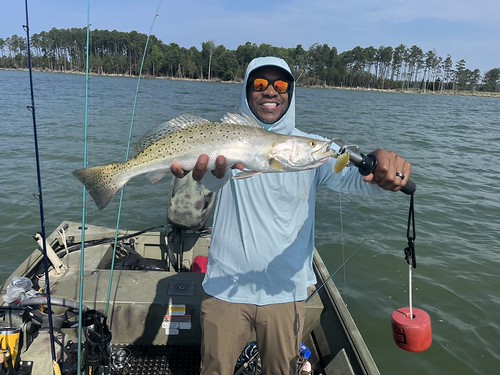
Rustin Moore holds a beautiful speckled trout he caught recently in the lower Bay. Photo courtesy of Rustin Moore
Milder temperatures are welcoming anglers to enjoy fishing across Maryland from the freshwater areas to the Chesapeake Bay and Atlantic waters. There is a wide variety of adventures waiting for anglers to explore.
The Maryland Department of Natural Resources (DNR) reminds anglers that water and air temperatures are elevated, and caution needs to be taken when fishing for striped bass.
Once anglers catch their daily limit, they should cease targeting striped bass and focus on other species, to limit the amount that are caught and released. If a striped bass isn’t a keeper, it should be released in the water without ever being removed.
Tips for safe catch and release are on the DNR website.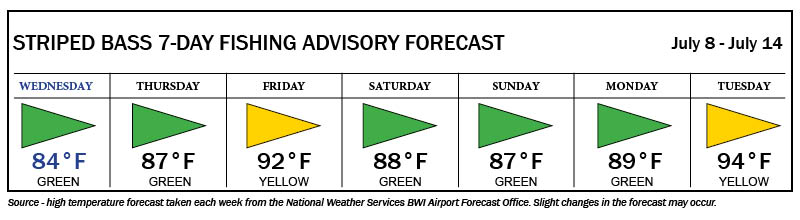
Forecast Summary: July 8 – July 14
Main Bay surface and river mouth water temperatures have risen to the low 80s and will likely continue to rise all week. Smaller rivers and streams temperatures are holding in the upper 70s. With warming waters, bottom oxygen levels are decreasing. Currently there is adequate oxygen in most Bay bottom waters except in the Potomac River, from near Indian Head to the Wicomico River and the Bay, from the Sassafras River down to the Bay Bridge area. The warm water and low oxygen in those areas impacts the amount of suitable habitat conditions for striped bass.
Expect below average flows for most Maryland rivers and streams. Expect average clarity for most Maryland portions of the Bay and rivers. To see the latest water clarity conditions on NOAA satellite maps, check Eyes on the Bay Satellite Maps. There will be above average tidal currents Sunday through Tuesday as a result of the July 14 full moon and resulting King Tides.
As always, the best fishing areas could be further refined by intersecting them with underwater points, hard bottom, drop-offs, and large schools of baitfish. For more detailed and up-to-date fishing conditions in your area of the bay, be sure to check out Eyes on the Bay’s Click Before You Cast.

Vince Tucciarella caught this large Chesapeake Channa in an upper Bay tidal river recently. Photo courtesy of Vince Tucciarella
Anglers fishing in the Conowingo Dam pool are seeing the dam turbines work in the evening, a typical summer power generation mode. Anglers are catching Chesapeake Channa and three species of catfish: Blue, flathead, and channel. Casting paddletails is a popular way to fish for Chesapeake Channa, aka snakeheads. Catfish are being caught by drifting cut bait close to the bottom. During the early morning and late evening, striped bass are being caught on a variety of topwater lures and crankbaits.
The lower Susquehanna and North East rivers provide additional striped bass fishing along the edges of the flats during the early morning hours, often before sunrise. Water temperatures are elevating under the hot sun, so striped bass are retreating to deeper waters. Catfish can also be found in the deeper channel areas.
Anglers are reminded that water temperatures are in the mid 80s and it’s time to shift away from catch-and-release fishing for striped bass. Fishing for blue catfish would be a better option to help preserve our striped bass resources for the future. Water and air temperatures are consistently high and areas are beginning to develop in the Bay where there is insufficient oxygen in the cooler depths for striped bass to recover from catch-and-release stress. Anglers should follow safe catch-and-release practices found on the DNR website.
Anglers are finding striped bass near Pooles Island, Swan Point, and Love Point this week. The most popular way to fish is live lining spot. The spot can be found in the shallower waters near the mouth of the Magothy River, the Chester River, and many shallower areas in the upper Bay. The influx of spot and small croaker have attracted the attention of increasing numbers of bottlenose dolphins, and they have moved up the Bay for the feast. White perch and small striped bass are also frequently on the menu. Large numbers of cownose rays are in the upper bay and can really stir up the waters as they work the shallow bottom areas for clams.
The early morning hours before and at sunrise are the best times to fish in the shallower waters of the upper Bay for striped bass. Shoreline structure and drop-off edges are good places to cast poppers, Zara Spooks, and paddletails. As the morning wears on, jigging along channel edges is another good option for those not live-lining spot. Trolling with umbrella rigs is another option for anglers.
Fishing for white perch in the tidal rivers and creeks is an option for anglers. The best times to fish are often in the morning and evening hours on a moving tide. Grass shrimp, peeler crab, or pieces of bloodworms work well on a bottom rig or casting small spinnerbaits and spin jigs near structure are good options. Chesapeake Channa can be found holding in the grass flats and a mix of blue and channel catfish can be found in all the region’s tidal rivers.
Middle Bay

Craig Roberts caught this bluefish near Sharps Island. Photo courtesy of Craig Roberts
There is a lot of good fishing for a mix of striped bass and bluefish along the edges of the main shipping channel this week. There are also good fishing opportunities for striped bass and white perch at the Bay Bridge and Kent Narrows and the mouth of the Choptank River.
Anyone who has been out on the water has noticed the invasion of sea nettles. The high salinity waters have brought them to the middle Bay, and they can be troublesome when fouling up lines or worse yet getting stung from handling lines. The stinging cells or nematocysts have a coiled, venom-laden, harpoon-like apparatus that is released when the cell is touched. If stung, washing with Bay water to remove tentacles and applying vinegar helps neutralize the sting.
Water temperatures are now in the 80s and the salinity is still high, registering 15 ppt in the middle of the Bay this week and as high as 5 ppt up the Choptank at the mouth of the Tuckahoe Creek. As water temperatures continue to elevate this month striped bass will be under stress. Anglers who catch their limit of slot size striped bass are urged to cease targeting them for catch and release. Instead, perhaps switch to fishing for the abundant bluefish or blue catfish .
Live-lining spot is the most popular and successful way to fish for striped bass this week. The 30-foot channel edges off Kent Island, Thomas Point, and south of Bloody Point down to Sharps Island and below the mouth of the Choptank River are good locations. The Kent Narrows is a good place to live-line or to jig. Bluefish can be pesky at times, often snipping off the back half of the spot and missing the hook. Saving the remains for drifting cut bait is an excellent way to catch bluefish.
Trolling is a good option for bluefish. A trolling spread with Drone spoons and surge tube lures pulled behind inline weights is a good way to target bluefish along channel edges. The bluefish being seen by anglers in the middle Bay are ranging from 3 to 6 pounds. They are good to eat whether broiled, baked, or grilled. Running a few through a smoker for a smoked bluefish spread will make you lots of friends.
Fishing for blue catfish is a good option for anglers looking for plenty of action and giving the striped bass a break. The Choptank River holds a lot of good eating blue catfish, and they have moved up to the Denton area and anglers are catching a lot of them on a variety of baits in the deeper channel waters. There is a good boat ramp in Denton at Crouse Landing for close by launching (you need a Caroline County boat ramp pass) and there is also good shoreline fishing available at the site. The Tuckahoe also provides good fishing for blue catfish.
White perch can be found in the region’s tidal rivers and creeks this month and offer good fishing close to home or port. Using grass shrimp, pieces of peeler crab or bloodworms on a simple one hook bottom rig is popular when fishing near docks and oyster reefs during a moving tide. This is a perfect opportunity for youngsters since no casting is involved, the perch are usually holding underneath the docks. During the early morning and late evening hours, casting small spinnerbaits and spin jigs along promising shorelines is a fun way to catch white perch, which are usually large.
Lower Bay
Water temperatures are on the rise in the lower Bay this week and are now in the mid 80s. There have been reports of the Potomac River water temperatures reaching the 90s above the Route 301 Bridge.
Fishing for striped bass is good this week and anglers can catch some within the 19-24 inch slot by live-lining spot, jigging or casting. Live lining spot is the most popular and successful way to fish for striped bass along the 30-foot edge of the region’s major channels The channel edge from St. Georges Island to Piney Point, the channel below the Route 4 Bridge in the Patuxent, Cedar and Cove Points and channel edges off Hoopers Island and Tangier Sound. Bluefish will be part of the mix and drifting fresh cut spot is a good way to catch them. Anglers are reminded that non-offset circle hooks are mandatory when targeting striped bass with live or cut bait.
Jigging along the same channel edges is another good way to catch striped bass. During the dawn hours and later sunset hours is a good time to try jigging as is casting a mix of lures in the shallower waters of the bay. Soft plastic jigs are popular for jigging and poppers, Zara Spooks, and paddletails are popular choices for fishing the shallows. Speckled trout are showing up in some areas.
Striped bass anglers are urged to limit catch-and-release fishing for striped bass; if you do, fish should be released in the water without being removed. Warm water temperatures and exposure to hot air are bad combinations for striped bass survival. Deep areas of low oxygen are beginning to occur in the lower Potomac and may evolve in other areas, which prevent striped bass from finding cool oxygen rich water to recover from a release. Tips for safe catch and release are on the DNR website.

Stefano Scottodifrega is certainly happy with this 8-inch crab. Photo courtesy of Stefano Scottodifrega
Bluefish are chasing bait in the lower Bay, and it is an exciting event when encountered by anglers. Approach from upwind and drift to the fish, rather than driving too close and ending the surface action. Casting metal jigs and spoons are popular ways to get in on the action. Large blips may show up on depth finders, revealing the presence of large red drum or cobia lurking underneath.
Most anglers who are targeting cobia are chumming and drifting live eels to the back of their chum slicks. Large red drum are providing exciting catch-and-release action when spotted by slicks, disturbed water or chasing menhaden. Anglers are also finding large sheepshead near the Target Ship and other submerged structure.
Fishing for spot could hardly be better; in many areas they are eating size. Spot are mixed with croakers, a fair portion of which are measuring over the 9-inch minimum. White perch may also be in the mix, and the perch can also be found farther up the tidal rivers and creeks. Smaller spot are being found in shallow waters.
Blue Crabs
Recreational crabbing has been an interesting proposition lately. Crabbers are catching 8-inch crabs in waters up to 20 feet deep and many feel the resource will be caught up soon. There are 5.5-inch to 6-inch crabs being caught in waters less than 12 feet and the shallows tend to hold a lot of small crabs. As a bit of a barometer, commercial trot liners are averaging 2 to 3 bushels of large and extra-large crabs per trip. Recreational crabbers are averaging a few dozen to a bushel depending on where one is crabbing. The lower Eastern Shore tends to produce some of the best catches

Xavier Nicholson holds up a large Chesapeake Channa caught in Loch Raven Reservoir. Photo courtesy of Xavier Nicholson
Although we seem to have put last week’s extreme temperatures behind us, water temperatures in the western and central region cold water trout management waters are elevated. DNR reminds anglers that during periods of high air temperatures and low rainfall, many of our coldwater streams reach temperatures that are stressful to trout. These fish are highly sensitive to water quality and require cold water with minimal siltation to thrive. When water temperatures rise, even properly handled trout face an increased risk of mortality following catch-and-release. DNR’s website provides advisory information for trout anglers during the summer.
The upper Potomac River received a bump in water flows from the recent rain but is still exhibiting typical summer flows. Anglers are fishing for smallmouth bass are making long casts with light lines during the early morning and evening hours. Root beer-colored tubes, swimbaits, and small crankbaits are good choices for targeting pools and current breaks. Topwater lures are always an exciting way to fish the edges of grass beds at dawn.
Largemouth bass and smallmouth bass are holding to a typical summer pattern of behavior. Water temperatures are elevated so they are mostly feeding during the night hours in the shallower areas of grass and structure. Soon after sunrise they retreat to cool shade that can be found under docks, fallen treetops and brush, and floating grass mats that are over water that is deep enough for bass to hold underneath. Wacky rigged worms and the new urchin soft plastics can be good choices to work slowly where bass are holding. Soft frogs, chatterbaits, and buzzbaits can be good choices to work over grass beds, spinnerbaits, jerkbaits and paddletails work well around the edges of grass beds in more open water.
Chesapeake Channa have no problem with warmer water temperatures and are very active this time of the year. Many are now off their spawn and actively feeding. Targeting grass beds in the upper sections of the Bay’s tidal rivers offers plenty of action. Soft frogs are one of the best baits to use over grass beds. Chatterbaits rigged with a soft white plastic craw bait or creature bait is another good choice. White paddletails are an excellent choice when working around the edges of grass beds.
Atlantic Ocean and Coastal Bays
The Ocean City beaches were a good place to be during last week’s heat wave. It was also a good time to be fishing along the beaches of Assateague. During the morning hours, kingfish are being caught in the surf on pieces of bloodworms or artificial bloodworm baits. Casting soft plastic jigs rigged with a strip of squid is a good way to catch flounder or a visiting blowfish. Anglers using larger cut bait continue to catch and release large red drum and a variety of small inshore sharks. Using finger mullet rigs is a good way to target bluefish in the surf.
At the inlet and the Route 50 Bridge area, anglers are catching a mix of striped bass and bluefish during the early morning and late evening or night hours. Flounder fishing has been good at the inlet and sheepshead are being caught near the jetty rocks, bridge piers and bulkheads on sand fleas. Fishing for flounder in the back bay channels is very good, and Gulp baits are catching some of the larger flounder.
Outside of the inlet anglers are catching a mix of bluefish and Spanish mackerel when trolling with Clark and Drone spoons behind inline weights. Flounder fishing is also good on many of the lumps and shoals. Farther offshore at the wreck and reef sites fishing for black sea bass has been good with a mix of flounder and triggerfish. The first small dolphin are beginning to arrive in the area, and a few have recently been caught.
Farther offshore, fishing for yellowfin tuna has been good and catch and release fishing for white marlin continues to improve. Offshore anglers are looking forward to small dolphin arriving at the lobster pot buoys for some fun light tackle action. Most charters are also scheduling time for some deep drop fishing to provide blueline and golden tilefish to take back to the dock. Anglers and boat captains are reminded that they must report tilefish catches electronically. The NOAA website contains the information anglers and boat captains need.
“Only those who become weary of angling bring nothing to it but the idea of catching fish.” – Rafael Sabatini, 1875-1950
Maryland Fishing Report is written and compiled by Keith Lockwood, fisheries biologist with the Maryland Department of Natural Resources.
The Forecast Summary is written by Tidewater Ecosystem Assessment Director Tom Parham.
A reminder to all Maryland anglers, please participate in DNR’s Volunteer Angler Surveys. This allows citizen scientists to contribute valuable data to the monitoring and management of several important fish species.
